Italian American Heritage Month and the Sunday Table
October has been Italian American Heritage and Culture Month since 1989. What the law says, what ti amo does not mean, and where the pairings go next.
Most heritage months in the United States came out of a campaign that lasted years before anyone in Washington paid attention. This one has a paper trail, and it is short enough to read in a sitting.
What the law actually says
Congress passed House Joint Resolution 392 and it became Public Law 101-128 on October 25, 1989, designating October of that year as Italian-American Heritage and Culture Month. The presidential proclamation had already been signed on October 12. Presidents have marked the month every year since, which is how a one-year resolution turns into a permanent fixture.
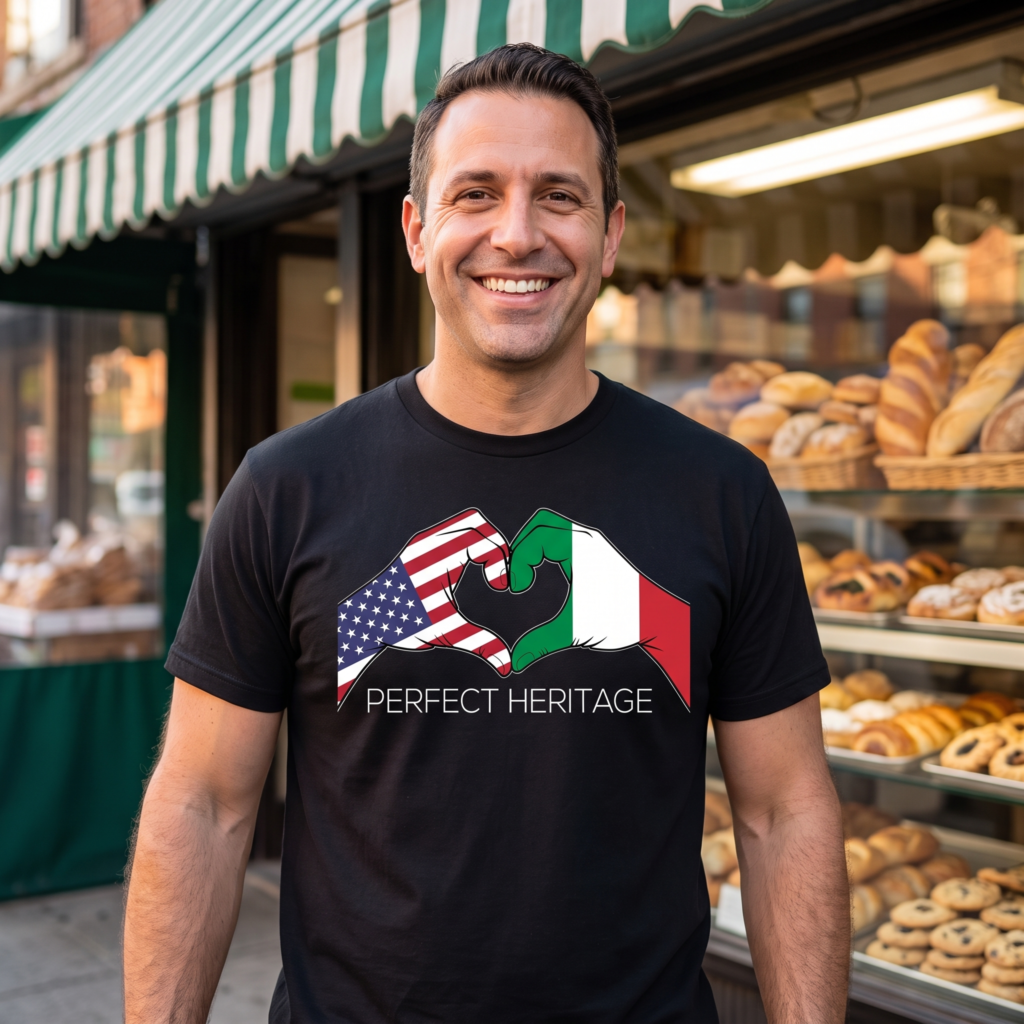
The scale behind it is easy to underestimate. In the 2020 Census, 16.8 million people reported Italian ancestry alone or in any combination, behind English, German and Irish. Those reporting Italian alone are concentrated hardest in New York and New Jersey, which between them account for over a quarter of that group. The Italian American Perfect Heritage Heart Tee is the plain version of all that: the Stars and Stripes on one hand, the green, white and red on the other, three equal bands the way the real flag draws them, and the black of the shirt left open as the heart between.
Ti amo is not ti voglio bene
Ti amo goes to a partner and to nobody else. Say it to a friend and the afternoon takes a turn. For family and for the people you have known since school, Italian uses ti voglio bene, which comes out literally as I wish you well and lands much closer to I hold you dear. English flattens both into the same three words and then wonders why the translation feels thin.
The Ti Amo, Italian I Love You Watercolor Tee prints the first one, so it is a gift for one specific person rather than a general warm feeling. Every language we draw splits the sentence somewhere, and the ten of them are set out side by side in How to Say I Love You in Ten Languages.

The Sunday table
Historians who have studied Italian Harlem in the 1930s describe the Sunday meal as something closer to a negotiation than a dinner. Immigrant parents gave American-born children a long leash outside the house, in exchange for turning up at the table. Food did the work that lectures could not, and it did it weekly.
The sauce itself traces back to the slow-cooked ragù of Naples and the south, where most of the migration came from. In Italy the meat flavored the sauce and then became the second course, because that was what a household could afford. In America the meat multiplied, which is what having arrived looks like on a plate. In some houses the whole thing is called gravy, an English word standing in for sugo, and the argument about which is correct has now outlived several generations of the people who started it.
None of this is folklore that ended. It is a Sunday that still happens, and a heritage shirt is what somebody wears to it, rather than a costume brought out once a year.
Two countries, and neither of them America
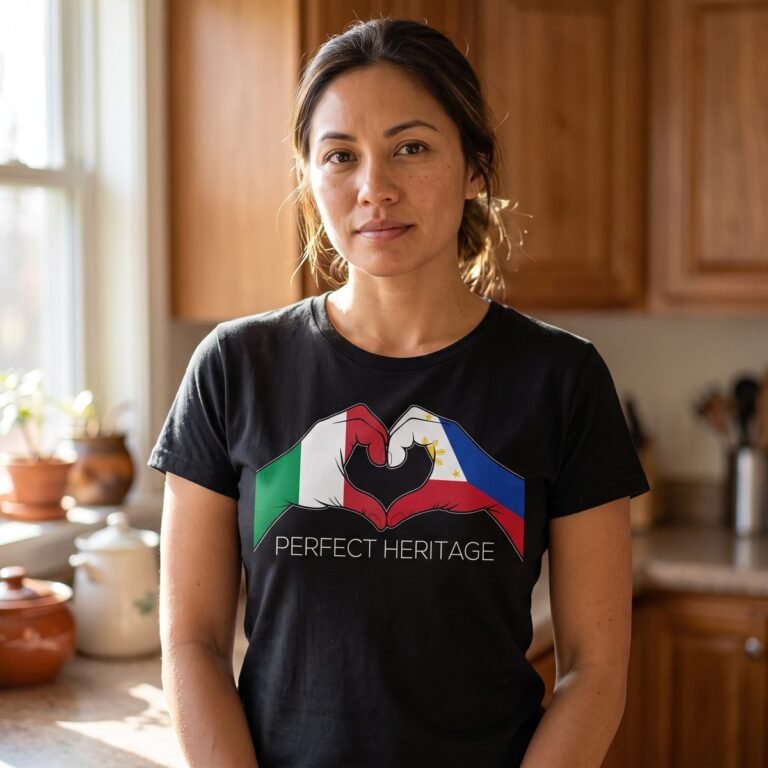
Italian heritage in the United States is not always half American. The Filipino community in Italy has been settled since the early 1970s, is concentrated around Rome, Milan and Lombardy, and is one of the larger non-EU communities in the country. Plenty of those households raise children who speak Tagalog at home and Italian at school, and some of them move on again to the United States and end up carrying three places instead of two. The Italian Filipino Perfect Heritage Heart Hands Tee exists because no rack anywhere prints that pairing.
The same is true across the water. Moroccans are among the three largest foreign communities in Italy, after Romanians and Albanians, and have been for decades. The Italy and Morocco Perfect Heritage Heart Tee draws the Italian tricolor on one hand and the Moroccan flag on the other, with the green star left open as five interlaced lines rather than filled in, which is how the real flag draws it and the single most common mistake on any print that uses it. Both designs live in American Heritage Hearts and the range beside it.
Questions people ask
When is Italian American Heritage Month?
October, every year. It was designated by Congress in 1989 as Italian-American Heritage and Culture Month, and a presidential proclamation has marked it annually since.
Should I put ti amo or ti voglio bene on a gift?
Ti amo for a partner. Ti voglio bene for a parent, a sibling or a friend. Getting it backward is not offensive, but it will be noticed and it will be repeated at family gatherings for years.
What if my family is Italian and something else?
That is what the two-flag designs are for. The pairings that include Italy and a second country outside the United States exist precisely because ordinary stores stop at Italian American and go no further.