First Class on the Paris Metro: the Story Behind the Ticket
The Paris metro carried two classes of passenger for most of a century, and the difference cost ten centimes. It ended, for good, in 1991.
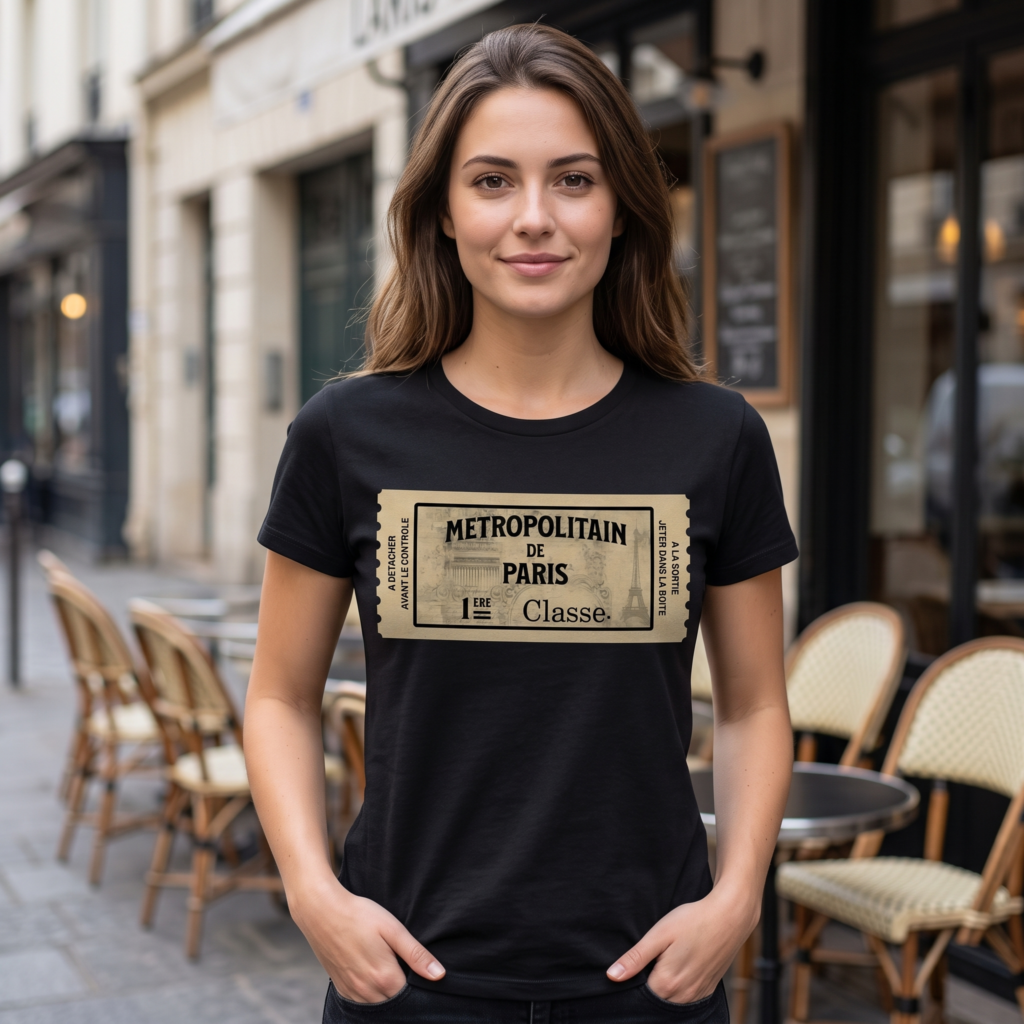
The first line of the Paris metro ran from Porte Maillot to Porte de Vincennes and opened to the public on July 19, 1900, in the year the city was holding the Exposition Universelle. The word over the staircase came from London. The Metropolitan Railway, opened in 1863, was known in French as the chemin de fer metropolitain, and the Paris operator took the name for itself as the Compagnie du chemin de fer metropolitain de Paris. That is why the sign says Metropolitain and not Metro, and why the shirt says it too.
Hector Guimard designed the entrances in the Art Nouveau style that people photograph without knowing whose they are. Eighty-six of them are still standing.
Two classes, and what ten centimes bought
For most of the twentieth century the trains were divided. A second class ticket cost fifteen centimes and a first class ticket cost twenty five, printed in red or turquoise blue, and what the extra ten centimes bought was a leather bench instead of wooden slats. That was the whole difference. Same tunnel, same train, same stops, better seat.
The end came slowly and then all at once. From 1982, holders of a second class ticket were allowed into the first class cars outside the busiest hours, which is usually the last stage of a distinction rather than a reform of it. The final first class service ran on July 30, 1991, at five in the afternoon, and first class was gone on August 1. A written question put to the French Senate that month recorded the point without sentiment: the disappearance of first class ended a situation that had no equivalent in the rest of the world.
What the ticket on the shirt says
The Metropolitain de Paris, Vintage First Class Ticket Tee prints one object at the size of a hand across the chest: a first class ticket on aged cream paper with scalloped perforations down both sides and a thin black frame inside them. METROPOLITAIN arches across the top in a heavy condensed serif, DE sits under it, then PARIS, then the class, 1ere, beside the word Classe in a lighter face. Behind the wording an engraving of a stone facade is printed faint, with the Eiffel Tower at the right edge.
Two lines of small capitals run vertically up the outer edges, inside the perforations. On the left, A DETACHER AVANT LE CONTROLE, tear off before inspection. On the right, A LA SORTIE JETER DANS LA BOITE, drop it in the box on your way out. Both were left in French and left uncorrected, because translating either one turns a real object into a tourist item. The instructions are the best part of the design and they are the part nobody reads first.
The design carries no date, on purpose
It is worth being exact about this, since the question comes up. The print is drawn in the manner of the old first class tickets. It is not a facsimile of any particular one. There is no year on it, no serial number, no station of issue and no price. What it reproduces is a type of object rather than a document, which is precisely what lets it work: it is a souvenir of a thing, not of a trip somebody else took. Anyone who tells you the ticket on the shirt comes from a given year is reading something that is not printed there.
The rest of the French corner
The shop has three other designs with France in them, and none of them is a beret. Je T’aime, Elegant French I Love You Script Tee writes the one line of French that needs no translation in white script across two overlapping watercolor washes, with flat crimson hearts breaking the softness. The white ink is the trick, since on black fabric it reads first and the words arrive before the paint does.

The France and Philippines Two Hearts Map T-Shirt belongs to a different family altogether: France on the left with Corsica included and a red heart set inland, the Philippine archipelago on the right drawn island by island, and a red dashed line running east between the two hearts. It is for Franco Filipino households, and the American branches of those families.
And Pride Paris, Skyline and Rainbow Letters Tee puts the city skyline along the top as a single white silhouette, the Eiffel Tower at the center and the domes of Sacre-Coeur to one side, with PRIDE below it in rainbow filled capitals and the same word again underneath, upside down and fading, as though reflected on wet ground.

The ticket shirt itself sits in Funny Tees. If you want the language rather than the map, How to Say I Love You in Ten Languages covers what je t’aime carries that the English does not.
Questions people ask
When did the Paris metro stop having a first class?
On August 1, 1991. The last first class service ran on the afternoon of July 30 that year. The class had been opened to all passengers outside peak hours since 1982, so by the end it survived mostly as a habit and a colored stripe on a ticket.
What does a detacher avant le controle mean?
Tear off before inspection. The companion line on the other edge, a la sortie jeter dans la boite, means drop it in the box on your way out. Both are printed on the design in small capitals running vertically, the way they ran on the paper.
Is the ticket on the shirt a real one?
No, and it is not meant to be. It is drawn in the style of the old first class tickets, with no date, no number and no station on it. Treat it as a portrait of an object rather than a scan of one, which is also why nobody can tell you what year it is from.