What Does 9mm Parabellum Mean?
Parabellum is the tail of a Latin sentence about peace, and it reached a cartridge box by way of a factory telegraph address. Here is the whole chain.
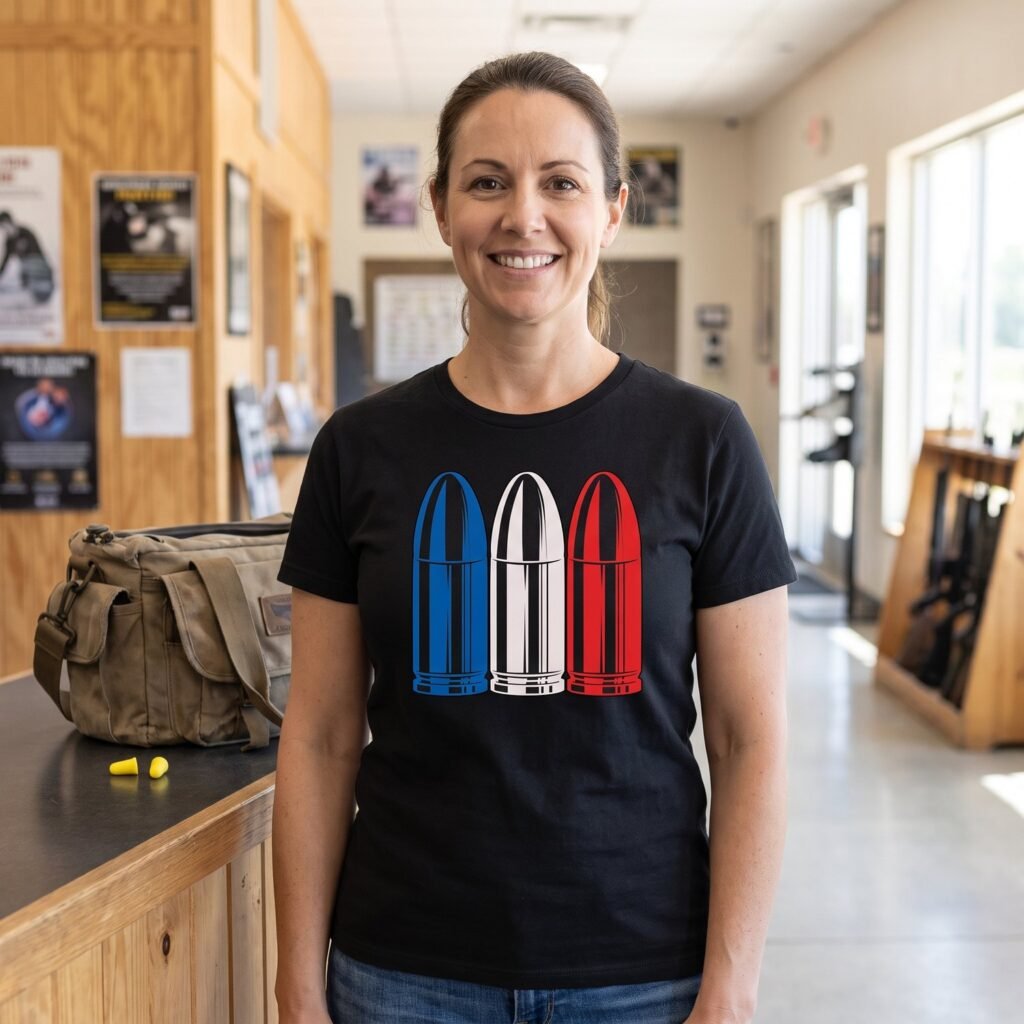
Parabellum is not a word. It is the last two words of a Latin sentence, run together and treated as a name. The sentence is si vis pacem, para bellum, if you want peace, prepare for war, and it has been on cartridge boxes for more than a century because of a company motto and a telegraph address.
Half of a Latin sentence
The saying is adapted from the Roman writer Publius Flavius Vegetius Renatus, in a military treatise usually called De re militari or Epitoma rei militaris, written in the fourth or fifth century. His actual line, in the prologue to the third book, is igitur qui desiderat pacem, praeparet bellum, therefore let him who desires peace prepare for war. The compressed version everybody quotes came later. The idea is older still and turns up in Plato, so it was already secondhand when the Romans had it.
How it got onto a cartridge
Deutsche Waffen und Munitionsfabriken, a German arms and ammunition maker usually shortened to DWM, used the Latin sentence as its motto, and Parabellum also served as the company telegraphic address. Georg Luger, an Austrian designer working there, developed the cartridge in 1901, and the pistol built around it was sold as the Pistole Parabellum. The German Imperial Navy adopted the cartridge in 1904 and the German Army in 1908.
Which is why the same round answers to three names. In Europe the CIP lists it as 9x19mm Parabellum. In the United States, where the industry body avoids cartridge names that are registered trademarks, it is 9mm Luger. On the shelf it is just 9mm. Same case, same dimensions, three labels.
The 9mm Parabellum in Blue, White and Red, France Tee prints three of them standing upright side by side, drawn in a bold vector style with thick black outlines: the left round cobalt blue, the middle one bone white, the right one deep red. Each shows the same anatomy, a rounded full metal jacket nose, the case mouth, the tapered body, the rim and extractor groove. There is no lettering and no flag drawn as a flag. The tricolor comes entirely from three colors in the right order, and the reader does the rest.
Why the AK 47 is called that
The Russian name is Avtomat Kalashnikova obraztsa 1947 goda: Kalashnikov’s automatic, model of the year 1947, after Mikhail Kalashnikov, who began the work in 1945 and presented the rifle for military trials in 1947. The Soviet armed forces accepted it in early 1949. So the 47 is the design year, not the adoption year, which is the detail most people get backward.
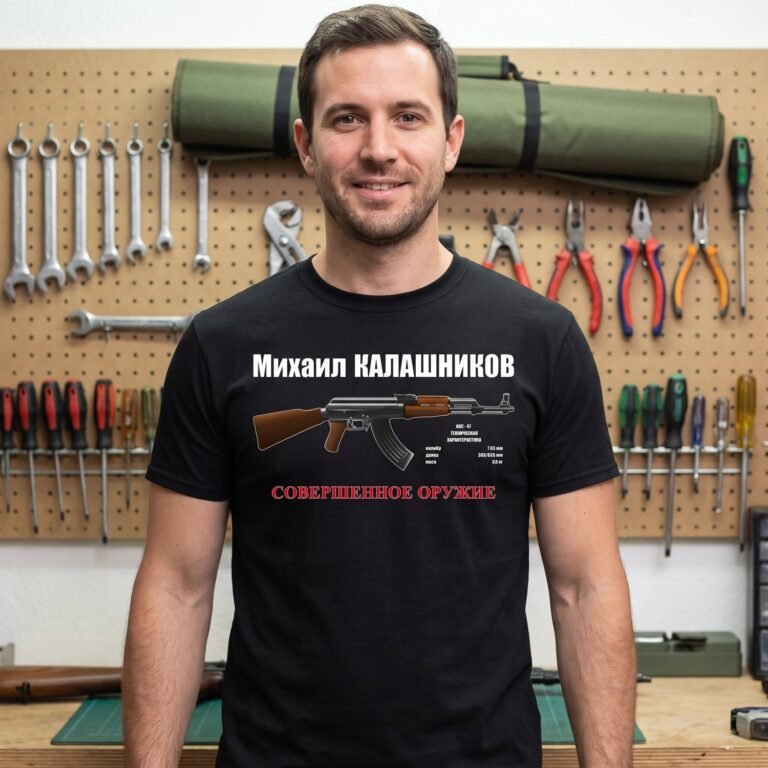
The Kalashnikov AK 47 Russian Technical Plate Tee is laid out like a page from a factory manual rather than a slogan shirt. The designer’s name runs across the top in heavy white Cyrillic. The rifle sits below it in profile across almost the full width, reddish brown wood for the stock, handguard and pistol grip, cold gunmetal for the receiver and barrel. A small stack of white text to the right does what a spec plate does, and a red line along the bottom, also in Cyrillic, translates as the perfect weapon. Nothing is translated on the shirt, which is the point.
Why the AR 15 is called that
Not assault rifle, and not automatic rifle. Both are common guesses and both are wrong. The AR comes from ArmaLite, the company where Eugene Stoner designed the AR 10 in 1956. ArmaLite’s own account is that the letters stand for ArmaLite Rifle. People close to the work have given other readings, including ArmaLite Research, and Stoner’s business partner said plainly that they were simply the first two letters of the company name. What none of the accounts do is make the letters stand for anything but the firm. ArmaLite sold the patent and the trademarks to Colt in 1959.
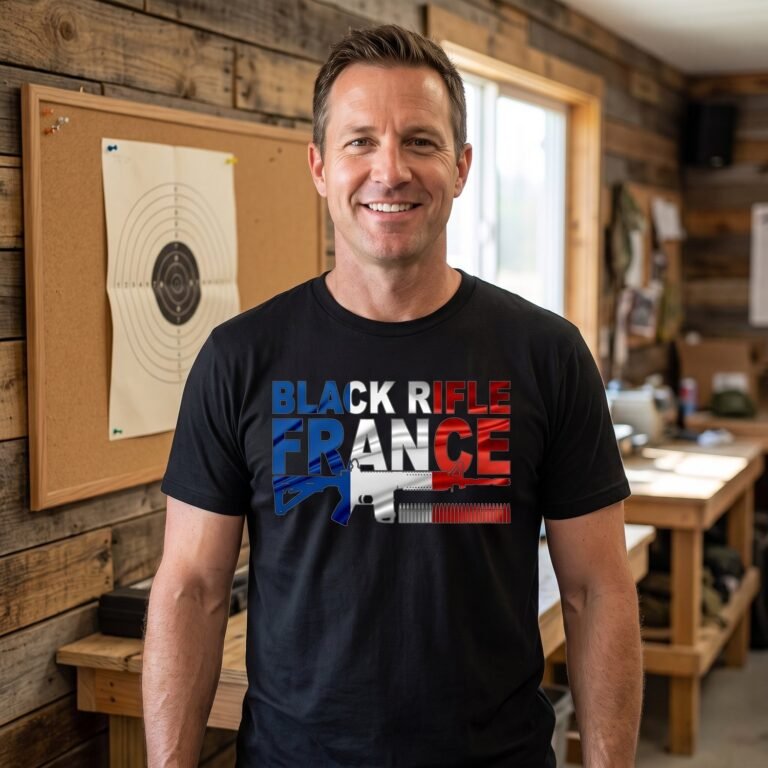
Two shirts print that rifle and they take opposite approaches. Black Rifle France, AR 15 in Tricolor Flag Colors fills the lettering and the rifle itself with a rippling blue, white and red, with a row of close to thirty cartridges standing shoulder to shoulder underneath the handguard. AR 15 Pop Art Rifle, Painted in Full Color drops the flag entirely and repaints every surface, hot orange across the stock, magenta through the lower receiver, teal and violet along the handguard, over a blotted background cut away from the shirt by a ragged white outline. It reads as artwork first and hardware second.
And then there is French Range Joke Tee, Not the Punchiest Primer, which has no ballistics on it at all, only three lines of white brush lettering in French about a primer that will not go off. The names on this page are Latin, Russian and American. That one is the only joke.
The rest of the family sits in Rifles and Calibers, and the shirts about range days rather than nomenclature are covered in shirts for a Saturday at the range.
Questions people ask
Is 9mm Parabellum the same as 9mm Luger?
Yes, and the same as 9x19mm. One cartridge, three names, which exist because the European and American standards bodies label it differently. Parabellum came from the maker’s motto and Luger from the designer, so the names credit the same company twice.
Does the AR in AR 15 stand for assault rifle?
No. It comes from ArmaLite, the company where the rifle family was designed in the late 1950s, and the accounts inside the company differ only on whether the R was for Rifle or for Research. Neither reading has anything to do with the word assault.
What is written in Russian on the AK shirt?
Two things. Across the top, the designer’s name, given name and surname in Cyrillic capitals. Along the bottom, in red, a phrase that translates as the perfect weapon. In between, a technical block listing caliber, length and weight the way a factory plate would.