Heritage Beyond the USA: When Neither Country Is America
Almost every heritage design on any rack assumes one of the two flags is American. Five in this shop do not, and the families they are drawn for are not rare.
Every heritage shirt on every rack makes the same assumption. One of the two flags is American. Italian American, Irish American, Mexican American: the second half of the phrase is fixed and the only variable is the first. That covers a great many families, and it quietly ignores a great many others.
The assumption on the rack
A Filipina who married in Milan and is raising children who speak Tagalog at home and Italian at school. A Japanese father and a Filipina mother in Nagoya. An Italian and a Moroccan family in Turin. None of these households has an American flag to put on the other hand, and none is going to find their combination printed anywhere.
Official paperwork took a long time to catch up too. The United States census did not let anyone give two answers to the race question until 2000, after the federal standards were revised in 1997 to require it. At the first opportunity, about 6.8 million people, 2.4 percent of the population, marked more than one. The category existed all along. The box did not.
Two flags, the same size
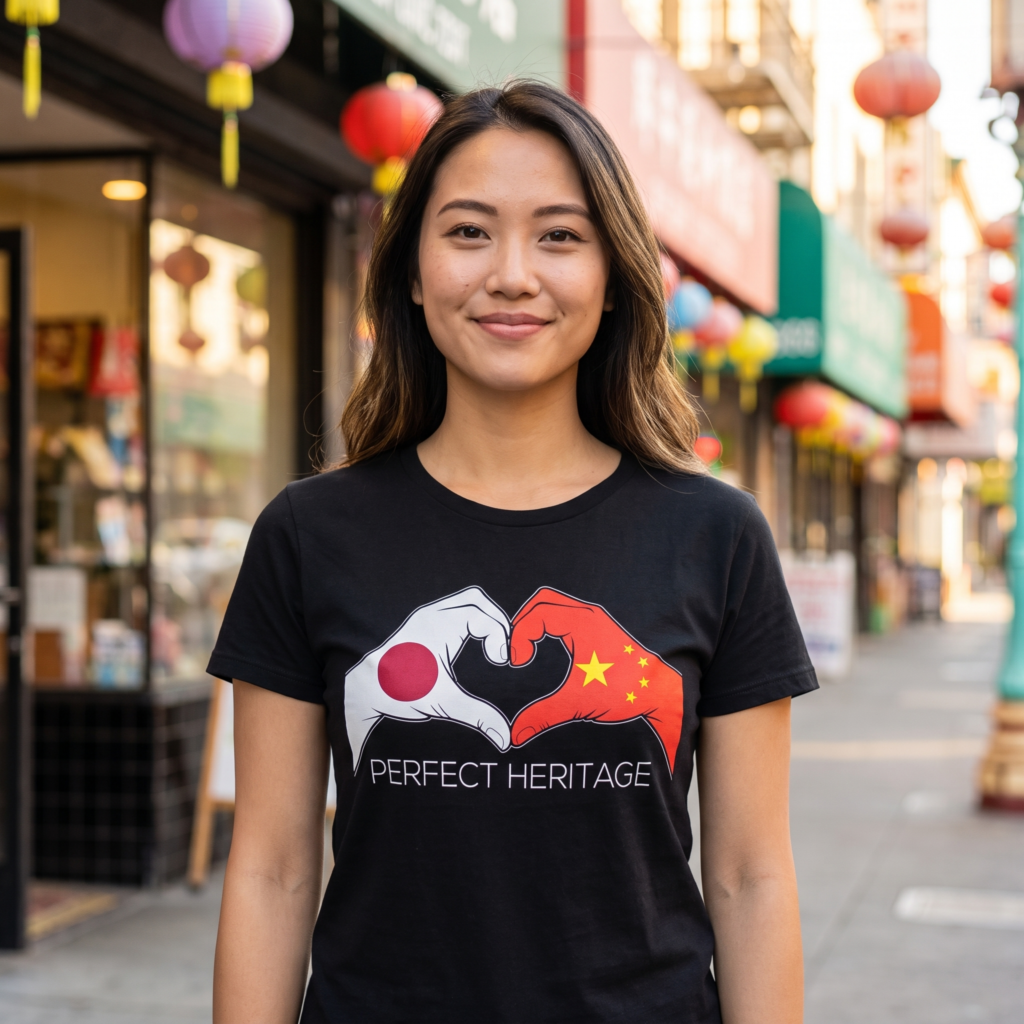
The Japan and China, Perfect Heritage Heart Tee is the plainest statement of the idea in the shop. Two hands meet at the fingertips and the thumbs to form a heart. The left hand carries Japan, almost entirely white with the red disc set in the palm. The right hand carries China, red across the whole hand with the large yellow star out toward the wrist and the four smaller ones curving after it. PERFECT HERITAGE runs underneath in thin white capitals.
The design argues its case by what it refuses to do. Neither flag is shrunk to make room for the other and neither is placed above it. The hands are mirror images, the heart between them is centered, and the only thing inside it is black cotton. Not a word of explanation is printed anywhere.
A pairing older than it looks
Japanese Filipino families read as a recent phenomenon. They are not. Japanese laborers began arriving in Davao in 1903, some of them coming on from a road building project in Baguio, to cut abaca for rope. Plantations multiplied, a district grew up around Mintal with its own shops and schools, and by the late 1930s Davao held one of the largest Japanese communities in Southeast Asia, around twenty thousand people. The war ended the community. It did not end the families.
The Japanese Filipino Perfect Heritage Heart Hands Tee uses the same two hands. The Japanese side is nearly bare white with its single crimson circle, and the Philippine side is full of color, the white triangle at the fingers holding the yellow sun and its three stars. It is the strongest contrast in the set, and the near empty hand is what makes the print legible from across a room.

Italy, twice over
The Italian embassy in Manila puts the Filipino community in Italy at around 165,000 people, arriving steadily since the early 1970s and concentrated in Lombardy and Lazio, much of it tied to domestic and care work. That is the household behind the Italian Filipino Perfect Heritage Heart Hands Tee, where the left hand wears the green, white and red and the right hand wears the Philippine flag. Its structure is identical to the Filipino American version with only the left hand changed, so a family can wear the two and have them read as a set.
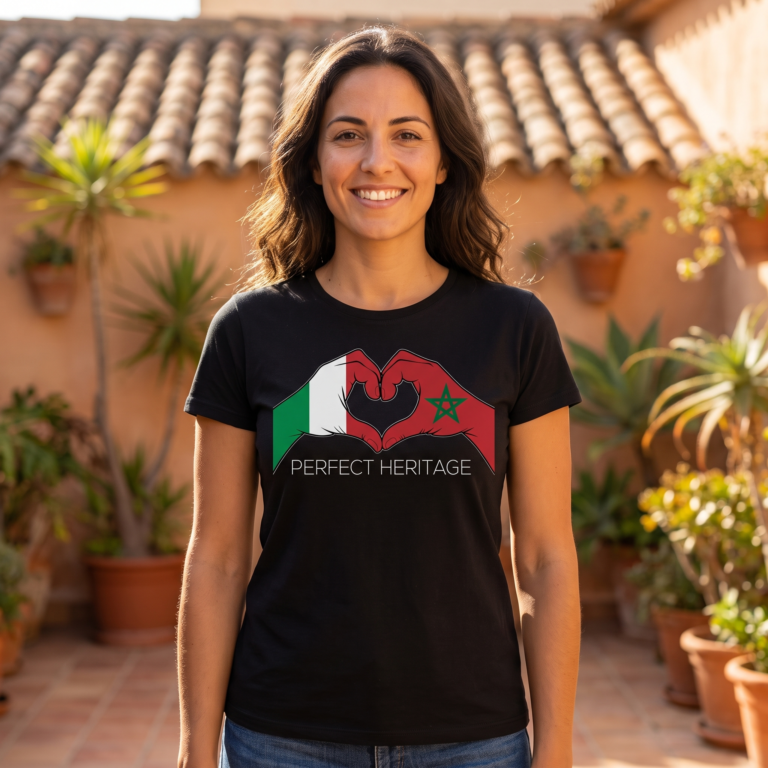
Moroccans are the largest non European community in Italy, which is how the other pairing comes to exist. On the Italy and Morocco Perfect Heritage Heart Tee the right hand carries a deep red field with the green pentagram open in the palm. Worth knowing why that matters: the Moroccan flag has carried an interlaced green pentagram since 1915, and the five lines pass under and over one another rather than filling in as a solid shape. Filling it in is the most common error on any print that uses that flag. Here you can follow each line.
The other way to draw it
Not every pairing is drawn as hands. The France and Philippines Two Hearts Map T-Shirt puts France on the left as a solid white silhouette with Corsica included and a red heart set inland, the archipelago on the right with a second heart on Luzon, and a red dashed line running east across the gap. The script under the maps is brushed rather than looped, which changes the tone of the whole print. Less wedding stationery, more luggage tag.
Choosing between the two families is simple enough. The painted hands are a portrait of a person who is both things at once. The maps are a portrait of a distance, and of the line crossing it. The pairs that leave America out entirely are in Heritage Beyond the USA, and the ones that include it are in American Heritage Hearts. The map designs get a closer look in the piece on two countries and one heart. Drawn here, printed and shipped by Amazon.
Questions people ask
What is a mixed heritage shirt?
A design that carries two countries at once instead of one. In this shop it takes two forms: two hands painted with a flag each, meeting to make a heart, or two map silhouettes joined by a dotted line.
Which flag goes on which hand?
The country named first in the product title is on the left hand, the second on the right. The pairs are drawn as fixed designs, so the arrangement is the same every time and two people can wear a matching pair.
Why are these pairings so hard to find anywhere else?
Because the market is organized around the American hyphen. A print that joins two countries with no American side has no obvious shelf to sit on, which is the reason the person wearing one tends to get stopped and asked about it.