Oktoberfest and German American Day: What Each One Marks
Oktoberfest began as a wedding reception with a horse race. German American Day marks thirteen families stepping off a boat in Philadelphia in 1683.

Two German dates fall a few weeks apart every autumn, and only one of them has anything to do with Germans in America. They get mixed up constantly, which is a waste: the one nobody has heard of is the better story.
German American Day, October 6
On October 6, 1683, thirteen Quaker and Mennonite families came ashore at Philadelphia. They had been living in Krefeld, near the Dutch border, having moved there to escape religious persecution, and in Pennsylvania they founded Germantown, now a neighborhood of the city. That landing is the entire reason the date is October 6.
Five years later, four men from the settlement wrote a two-page condemnation of slavery and sent it up through the Quaker meetings. The 1688 Germantown petition is one of the earliest written protests against slavery in the English colonies, and it came out of a village that was five years old.
The observance itself is recent. President Reagan proclaimed October 6 German American Day in 1983, for the three hundredth anniversary of Germantown, and Congress passed a resolution in 1987. German is one of the largest ancestries reported in the country, 45 million people in the 2020 Census, and it is also one of the quietest. The German American Perfect Heritage Heart Tee puts the Stars and Stripes on one hand and black, red and gold on the other, and leaves the black of the shirt as the heart between them. No stein, no lederhosen joke.
What Oktoberfest is actually for
Crown Prince Ludwig of Bavaria married Princess Therese of Saxe-Hildburghausen on October 12, 1810. The celebrations ran for days, and on October 17 a horse race was held on the open fields outside the city gates. The ground was then named Theresienwiese, Therese’s meadow, after the bride. Munich has been holding the party on that same field ever since, and locals still call it the Wiesn.
The dates move, and the rule behind them is administrative rather than romantic. The festival opens on a Saturday in September and runs sixteen days, ending on the first Sunday in October. If that Sunday falls before October 3, German Unity Day, the whole thing is extended to cover it. Which is how an event named after October ends up mostly in September.
Only beer brewed inside the Munich city limits and to the Reinheitsgebot may be sold there as Oktoberfestbier. Six breweries qualify, and that is the whole list. At noon on the opening Saturday the mayor taps the first barrel and says O’zapft is, and until that happens nobody else is allowed to pour.
Where Americans keep it
Cincinnati runs the largest one in the country. Oktoberfest Zinzinnati has been held since 1976, draws more than 800,000 people, and holds the world record for the largest chicken dance, set in 1994 with over 48,000 participants. It also races dachshunds in hot dog costumes, which is not a thing Munich does.
La Crosse, Wisconsin, has run its own since 1961. Wurstfest started the same year in New Braunfels, Texas, a town Germans founded in 1845, and now runs ten days in early November. New York does something else entirely: the German American Steuben Parade has gone up Fifth Avenue on the third Saturday in September since 1957, named for the Prussian officer who trained Washington’s army.
Three words Germans do not spend lightly
Ich liebe dich is not the everyday phrase English speakers assume it is. It is kept for a partner and it is meant completely. For a child, a sibling or an old friend, German reaches for ich hab dich lieb, which is warm without being a declaration. Printing the first one across a chest is a decision, not a decoration, and the Ich Liebe Dich, German Watercolor Heart Tee treats it that way: dark cocoa script over a painted heart, quiet from across a room and legible at arm’s length. Most languages split the sentence like this, and the ten we print are laid out in How to Say I Love You in Ten Languages.

The Czech line in the same story
The two countries share a border and a brewing history worth getting the right way around. In 1842 the burghers of Plzeň, in Bohemia, built a new brewery and hired a Bavarian to run it. He produced the first batch of pale lager on October 5 that year, using the town’s soft water, hops from Žatec and Moravian malt. That beer is the ancestor of most of the beer brewed in the world today. Czech, made by a German, which is roughly how the region has always worked.
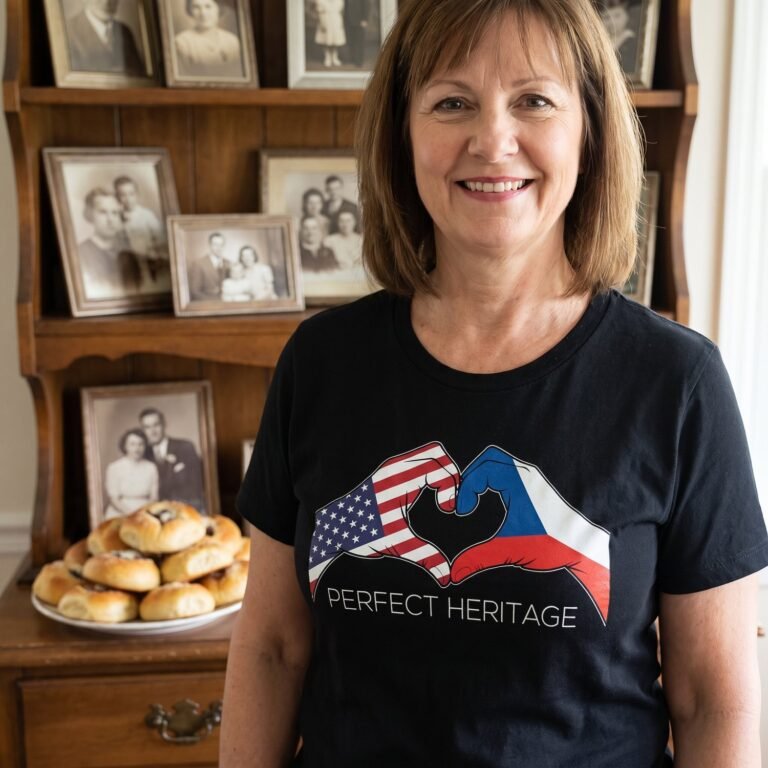
Czech families in America settled mostly across the Midwest and Texas. Nebraska has the highest share of Czech ancestry of any state, Wilber holds a Czech festival every year, Texas has a belt of Czech towns, and Cedar Rapids, Iowa, keeps the national Czech and Slovak museum. The Czech American Perfect Heritage Heart Tee puts the blue triangle on the hoist side and the white band above the red, the two details people from the country check first. It sits with the rest of the range in American Heritage Hearts.
Questions people ask
Why is Oktoberfest held in September?
Because the rule counts backward from the end. The festival closes on the first Sunday in October, or on October 3 if that is later, and runs sixteen days, so the opening Saturday falls in September. The name comes from the 1810 original, which really was in October.
What does German American Day celebrate?
The arrival of the first German-speaking settlers at Philadelphia on October 6, 1683, and the founding of Germantown. It was proclaimed in 1983 and given a congressional resolution in 1987.
Is a German heritage shirt only for Oktoberfest?
No, and that is rather the point of drawing one. Two flags on a chest say where a family came from on any day of the year. A costume cannot.