Filipino American History Month and the Landing of 1587
The month is not built on a treaty or a wave of arrivals. It is built on one afternoon on the California coast, thirty-three years before Plymouth.
October is Filipino American History Month in the United States. Most observances of this kind mark an independence day, a treaty or the arrival of a generation. This one marks a single afternoon on the California coast, before there was a United States to arrive in.
What happened on the California coast
On October 18, 1587, a Spanish galleon sailing the Manila route put a landing party ashore near what is now Morro Bay, California. The crew included men from Luzon, written into the Spanish records as Luzon Indios. The California historical marker at the site calls it the first landing of Filipinos in the continental United States. Two days later the party was attacked by local people, one of the Filipino crewmen was killed, and the ship gave up on the coast.
The arithmetic is the part that stops people. The Pilgrims reached Plymouth in 1620. This was thirty-three years earlier.
Nothing was founded that day. No settlement, no colony, nobody stayed. The men were crew on a trading ship and the ship sailed on. That is what makes the date work as an anchor: it marks a presence rather than a claim.
The month was created by a historical society
Filipino American History Month did not come down from Washington. The Filipino American National Historical Society, founded in Seattle in 1982 by Dorothy Laigo Cordova and Fred Cordova, proposed the month in 1991 and held the first observance in October 1992. October was chosen for the 1587 date and nothing else.
Congress caught up in 2009, when both chambers passed resolutions recognizing October as Filipino American History Month, House Resolution 780 and Senate Resolution 298. Neither made the designation permanent, which is why a fresh resolution still has to be introduced in most Congresses instead of the month standing alone.
The name says history and not heritage, and the society that created it is explicit about the difference. Heritage is what gets handed down, the food and the language and the songs. History is what people did once they were here.
What the month actually covers
Three strands turn up in almost every October program, and none of them is food.
The first is a fishing village called Saint Malo, in the marshes of Lake Borgne in Louisiana, settled by sailors who left the Manila galleons. It is usually dated to 1763 and called the first permanent Filipino settlement in the country. That date deserves a footnote: the oldest surviving account of the village is a magazine article from 1883, so 1763 is a tradition carried forward rather than a document anyone can produce.
The second is farm labor. On September 8, 1965, Filipino farm workers of the Agricultural Workers Organizing Committee, led by Larry Itliong, walked out of the table grape vineyards around Delano, California. The Mexican American union joined them, the two organizations merged, and the strike most people remember under another name began as a Filipino walkout.
The third is the hospital. Filipino nurses are the largest group of foreign educated nurses working American floors, and that history runs back to the nursing schools opened in the Philippines under American rule from 1906, where the language of instruction was English.
The shirts that come out in October
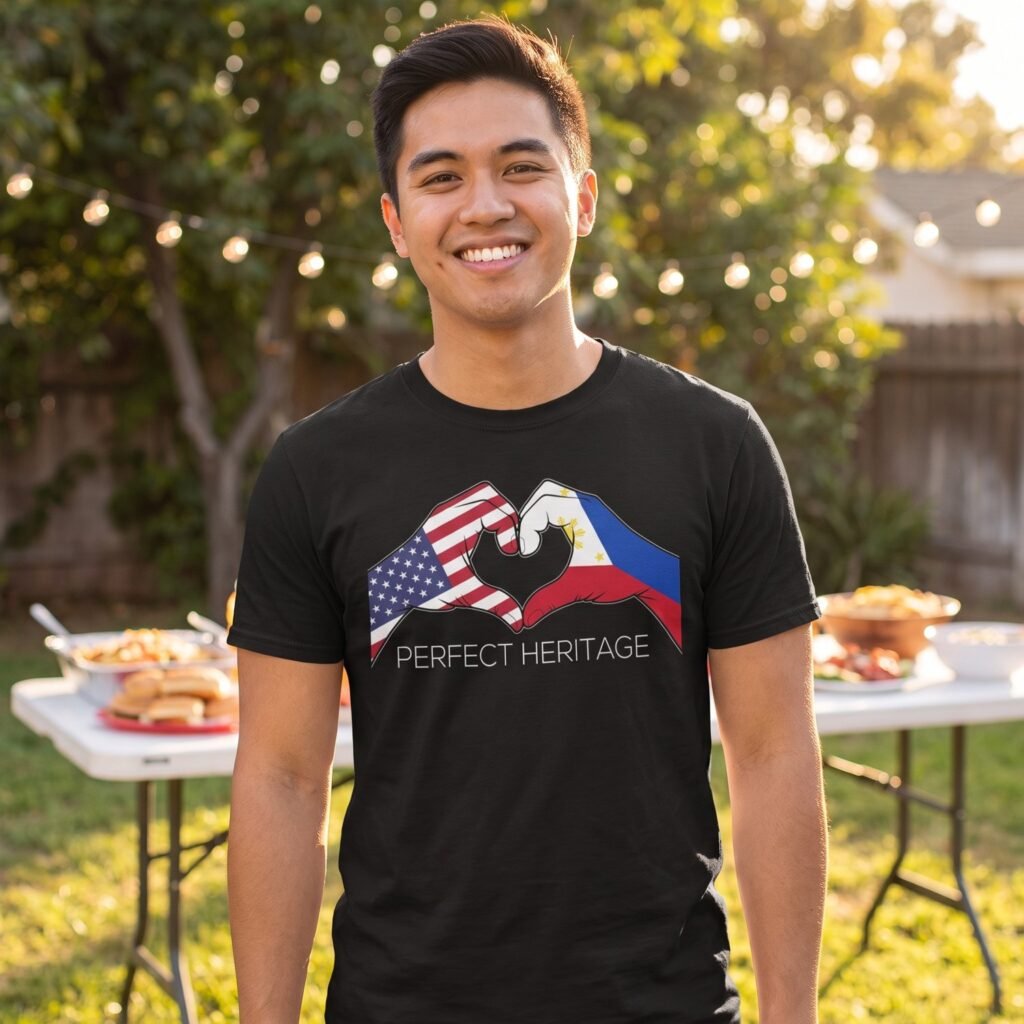
The heritage designs in this shop all use one gesture. Two hands meet at the fingertips and the thumbs to form a heart, one hand painted with each flag, and the middle is left open so the shirt itself shows through. On the Filipino American Perfect Heritage Heart Hands Tee the left hand carries the stars and stripes and the right hand carries the Philippine flag, the white triangle and the eight ray sun at the fingers. Two words sit underneath, PERFECT HERITAGE, and nothing is printed inside the heart. That empty space is the argument: neither flag is larger, and neither is on top.
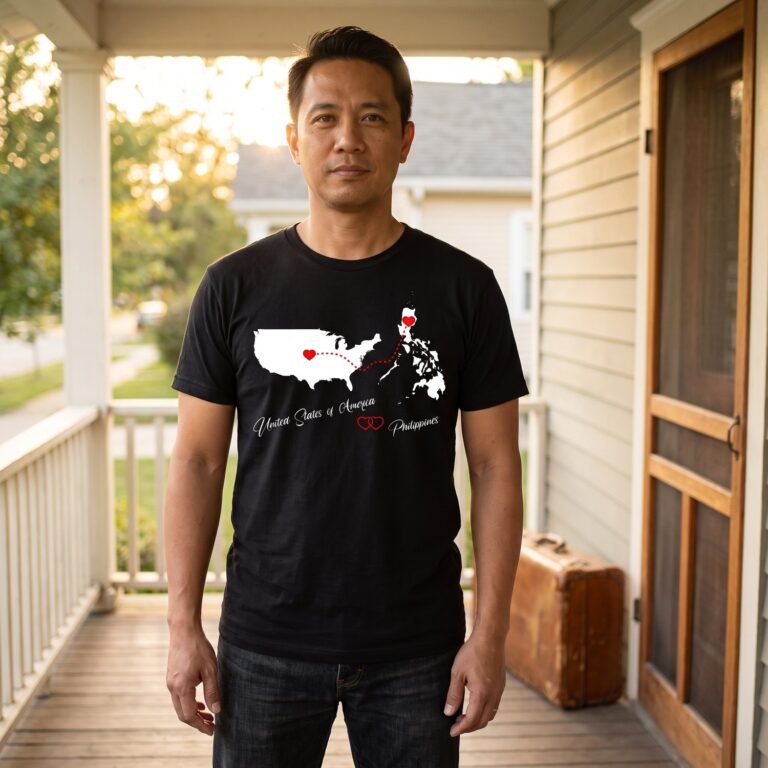
The same relationship can be drawn as a map. The United States and Philippines Two Hearts Map Tee puts the continental United States on the left and the archipelago on the right, a red heart on each, and a dashed red line curving between them the way a flight path does. One heart is dropped inland rather than on a coast, which makes the print read as a route, not a border.
For nurses there is a version in Tagalog. The Nurse Ako Tagalog Proud to Be Filipino T-Shirt runs the flag straight through the three letters of AKO. Ako means I, and Tagalog puts no verb between the pronoun and the noun, so nurse ako is a finished sentence in two words.
Then the two words a Filipino family saves for the moment that counts. The Mahal Kita Elegant Filipino Love T-Shirt sets them in a fine burgundy script on a brushed watercolor heart, and the Mahal Kita Always, Pinoy I Love You Brush Tee throws them across the chest in pink and turquoise brush lettering with always added, which turns a statement into a promise. Everything Filipino in the shop sits in Filipino Pride, and the December half of the story is in the guide to Pasko and the ber months. Drawn here, printed and shipped by Amazon.

Questions people ask
When is Filipino American History Month?
The whole month of October, every year. The event it commemorates happened on October 18, 1587, but the observance covers the month rather than the day.
Why October and not June 12, Philippine Independence Day?
June 12 marks the proclamation of independence from Spain in 1898 and belongs to the Philippine calendar. October marks the earliest documented Filipino presence in what is now the United States. They answer two different questions, and plenty of families keep both.
Is Filipino American History Month a federal holiday?
No, and it is not a holiday of any kind. Congress has recognized it by resolution rather than statute, and never permanently. Cities, states, school districts and universities mark it on their own.